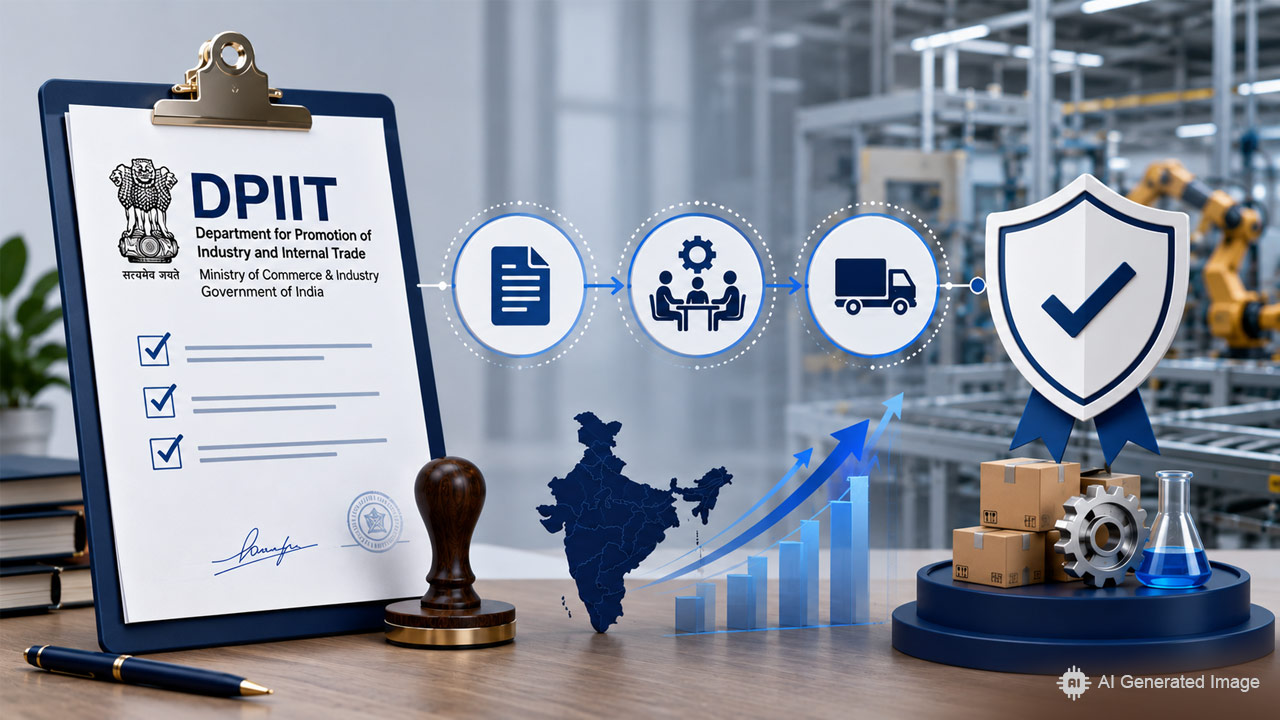
India has taken another step towards simplifying product quality compliance for manufacturers.
The Department for Promotion of Industry and Internal Trade (DPIIT) has issued detailed operational guidelines to implement the Transition Facilitation (Quality Control) Order, 2026.
An alternative pathway has been introduced for companies seeking product quality certification under selected Quality Control Orders (QCOs). The move is expected to ease compliance, strengthen domestic supply chains and support businesses transitioning to stricter quality standards without compromising consumer safety.
Also Read: DPIIT Pushes Automation in Explosives Manufacturing to Improve Industrial Safety
Alternative Certification Route Now Operational
The guidelines follow the Transition Facilitation (Quality Control) Order, issued earlier on 25 June 2026.
Under the new framework, manufacturers covered by 10 selected quality control orders are eligible to apply for product certification through a compliance mechanism, rather than relying solely on the conventional route.
The framework covers sectors including toys, personal protective equipment (PPE), air conditioners, compressors, footwear, furniture, hinges, domestic electrical appliances and household electrical safety products.
Also Read: India Plans ₹7,100 Crore Semiconductor Incentives in FY27 to Accelerate Chip Manufacturing Growth
How Will the New System Will Work?
Applications will be reviewed by an Implementation Committee, chaired by DPIIT, with representatives from the Bureau of Indian Standards (BIS), the Department of Commerce, the Department of Consumer Affairs, the Directorate General of Foreign Trade (DGFT) and other ministries.
Eligible companies incorporated under the Companies Act, 2013 must submit details of the products, annual production quantities and manufacturing facilities. Businesses planning to develop supply chain capabilities in India must also outline their investment plans, technology adoption plans, research and development initiatives, proposed locations and implementation timelines.
A notable feature of the guidelines is that the committee will not conduct physical inspections of manufacturing units when assessing applications, relying instead on information submitted by applicants.
Also Read: WT-MARUT: India’s First Wind Turbine Supply Chain Portal to Strengthen Manufacturing and Exports
Focus on Innovation and Domestic Manufacturing
The alternative pathway is designed to support manufacturers that demonstrate strong technical capability, a reliable compliance record and a commitment to innovation. Companies investing in technology upgrades, product design, research and development, or strengthening India’s supply chains are expected to benefit under the new framework.
The government says the mechanism is intended to make regulatory compliance more practical while maintaining product quality and supporting the growth of domestic manufacturing.
The new guidelines could reduce compliance bottlenecks for manufacturers operating in sectors covered by Quality Control Orders. The success of the framework will now depend on how quickly applications are processed and whether the simplified route helps companies expand production while maintaining India’s quality standards.

Samarjit Kaur is a journalist and communications professional covering technology & emerging digital trends. With a focus on clarity and context, she reports on developments shaping industries and governance. When not reporting, she chooses to plug-in and relax on her playlists and plan her next bucket-list trips!