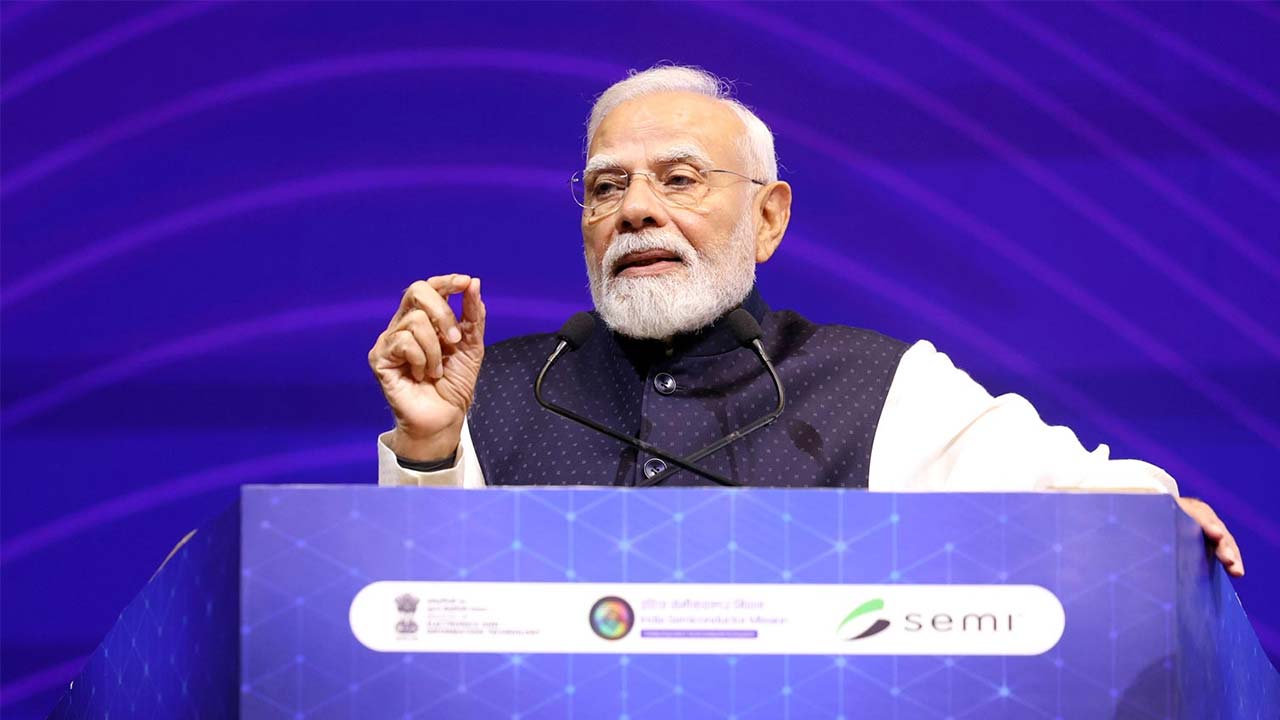
Prime Minister Narendra Modi has positioned India as a “new and trustworthy” destination for semiconductor manufacturing at Semicon India 2026.
He said that the country’s growing chip ecosystem could help strengthen global supply chains at a time when supply chains are increasingly being “weaponised”.
Speaking at the inauguration of Semicon India 2026 at Yashobhoomi in New Delhi, Modi said India was preparing to meet the global demand for reliable manufacturing locations. He said the government was taking steps across policy, regulation and infrastructure to support the semiconductor industry.
India Expands Semiconductor Mission as Projects Grow
PM Modi said 12 semiconductor projects have been approved so far, with more expected in the next phase. The India Semiconductor Mission 2.0 has an outlay of $13.5 billion, up from $8 billion under the first phase.
The Prime Minister said India’s semiconductor push was no longer limited to chip design and assembly. The country is building capabilities across fabrication, advanced packaging, equipment, materials, research and talent.
He also pointed to progress since the semiconductor programme began in 2022, saying India has moved from policy discussions and project planning to pilot production and commercial output. Chips produced in India have now started reaching customers in the country and overseas.
The government is also working to strengthen the wider supply chain, including fabless companies, intellectual property, equipment, chemicals, gases and materials. Modi highlighted silicon photonics as an area important for infrastructure supporting artificial intelligence.
Also Read: India Pushes Critical Minerals and Semiconductors to Reduce Foreign Dependence: PM Modi
AI, Power and Talent Emerge as Key Priorities
The Prime Minister linked the semiconductor opportunity with the rapid growth of artificial intelligence. He said chip development was increasingly about the wider system, including memory and heat management, rather than simply making smaller transistors.
Power supply was another focus. AI data centres and semiconductor manufacturing require large amounts of reliable electricity. Modi pointed to India’s expanding power capacity, including more than 160 GW of solar capacity, the opening of nuclear energy to private players and work on small modular reactors.
Talent and research were also central to his address. The government aims to train one lakh engineering students in chip-related skills, with 70,000 already trained, Modi said. He urged researchers working in India and abroad to contribute to advanced technology development in the country and called on industry leaders to increase research and development in India.
The broader message from Semicon India 2026 is that India wants to build the semiconductor ecosystem as a complete chain rather than focus on individual factories.

Samarjit Kaur is a journalist and communications professional covering technology & emerging digital trends. With a focus on clarity and context, she reports on developments shaping industries and governance. When not reporting, she chooses to plug-in and relax on her playlists and plan her next bucket-list trips!