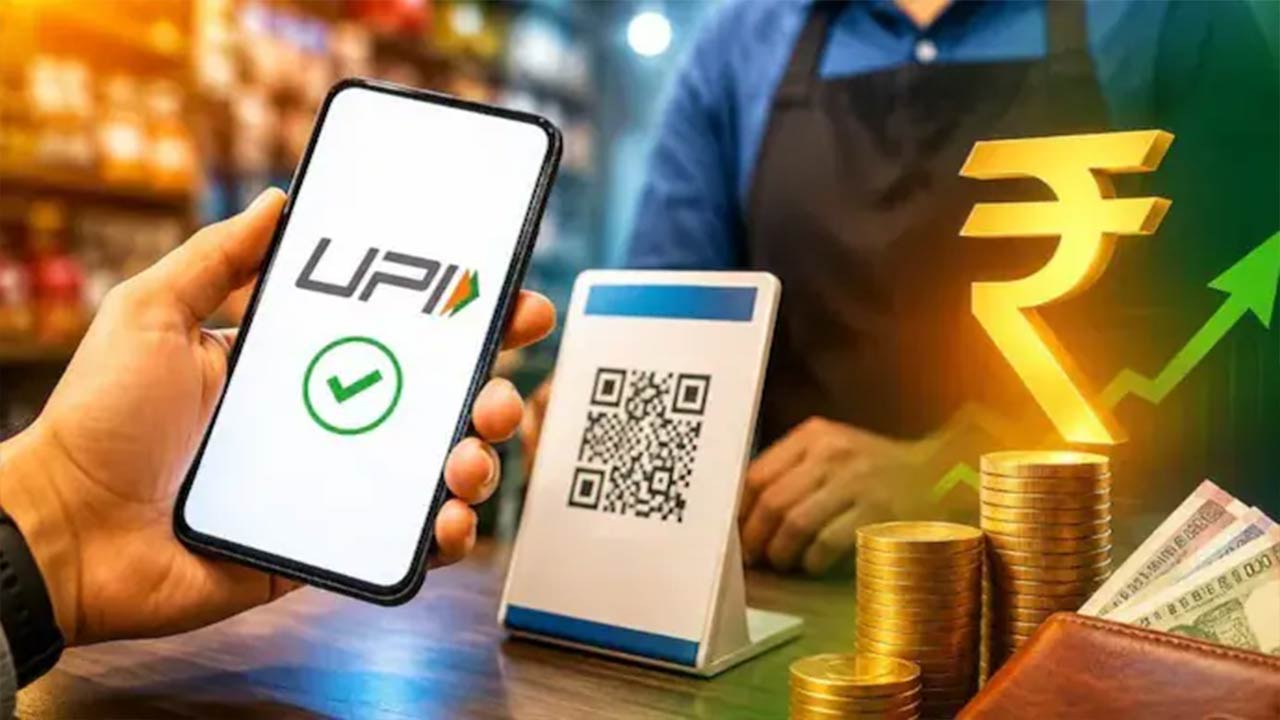
For millions of Indians, scanning a QR code and paying through the Unified Payments Interface (UPI) has become almost as routine as handing over cash or using a card. That is why the announcement of UPI charges or the new Merchant Discount Rate (MDR) has raised questions about whether the era of free UPI payments is coming to an end.
The short answer is: UPI charges are not for consumers, and not for all UPI transactions.
From October 15, 2026, the National Payments Corporation of India (NPCI) will introduce a 0.4% MDR on eligible person-to-merchant (P2M) UPI charges for transactions above ₹2,000. The merchant, rather than the payer, will bear the charge. For transactions of ₹75,000 and above, the MDR will be capped at ₹300 per transaction.
Person-to-person (P2P) payments will remain free. P2M transactions of up to ₹2,000 will also continue without MDR. According to reports citing the new framework, such small-value payments account for more than 95% of P2M UPI transaction volume.
Also Read: UPI Transaction Charges: Banks Cannot Charge Users for Payments Up to ₹2,000
UPI Charges: What Changes for Users from October 15, 2026?
The most important distinction is between who makes the payment and who receives it.
If you send ₹5,000 to a friend or family member, the transaction remains free. This is a P2P payment.
If you pay a shop, business or other merchant ₹1,500 through UPI, there is also no MDR.
The new UPI charges apply to eligible P2M transactions above ₹2,000.
At the standard rate of 0.4%, a ₹3,000 merchant payment would generate an MDR of ₹12. A ₹50,000 transaction would attract ₹200. Once the transaction reaches ₹75,000, the ₹300 cap applies. Therefore, even a ₹1 lakh eligible transaction would carry a maximum MDR of ₹300 rather than ₹400.
| UPI Charges on Transaction | MDR Under the New Framework |
| Person-to-person payment | No MDR |
| Merchant payment up to ₹2,000 | No MDR |
| ₹3,000 eligible merchant payment | ₹12 |
| ₹50,000 eligible merchant payment | ₹200 |
| ₹75,000 and above | Capped at ₹300 |
There are also exemptions and special rates aimed at smaller businesses and sectors where margins are typically tighter. Merchants receiving up to ₹1 lakh a month through eligible UPI QR transactions are to remain outside the MDR levy.
Certain categories, including railways, telecom, insurance, fuel and utilities, will have a flat ₹5 MDR on applicable transactions rather than the standard 0.4% rate.
This means the headline “UPI will no longer be free” needs qualification and rectification. UPI continues as a free service for consumers under the announced structure, while a large portion of everyday, lower-value merchant payments will remain outside the MDR framework.
The change primarily introduces a revenue mechanism on the merchant side of the UPI ecosystem.
UPI has operated for years without a conventional MDR on these transactions. Banks, payment service providers, payment apps and other participants have nevertheless had to maintain the infrastructure required to process payments, manage security, prevent fraud and keep the network available at scale.
The new framework is intended to create a commercial mechanism around some higher-value merchant transactions while retaining zero MDR for small-value payments and P2P transfers. Reports citing the framework say the proceeds are expected to support areas such as payment infrastructure, cybersecurity, innovation and customer service.
Will UPI become more expensive for consumers?
For now, the answer is no direct consumer charge has been announced.
The UPI charges, or MDR, are a merchant-side charge. The merchant’s acquiring bank and the wider payment ecosystem handle the fee. The government has also advised banks to ensure that merchants do not pass the newly introduced charge on to customers.
That distinction matters.
Suppose a customer buys a product worth ₹5,000. At 0.4%, the applicable MDR would be ₹20. The announced framework does not mean the customer should suddenly see a ₹20 “UPI fee” added to the bill.
However, whether merchants absorb the cost or adjust their pricing over time is a separate commercial question. Businesses already factor payment processing costs into their overall operating expenses.
Some may absorb the MDR, while others could adjust pricing, payment methods, or other costs as they assess the impact on margins.
A government-mandated consumer charge differs from a business responding to a new operating cost. This framework has not introduced the first.
The change also does not mean that every merchant will suddenly have to pay MDR. The exemption for smaller merchants receiving up to ₹1 lakh a month through eligible QR transactions is designed to keep the smallest businesses outside the new charge structure.
The bigger question is what this means for UPI’s economics.
UPI has grown into one of the world’s largest real-time payment systems. In August 2026 alone, it processed about 24.5 billion transactions worth ₹29.8 trillion.
At that scale, even a small fee on a defined segment of transactions can create a significant revenue pool for the financial and payments ecosystem. Industry estimates put the potential annual revenue from the new MDR framework at up to ₹16,000 crore. However, the actual amount will depend on transaction volumes, exemptions and how the revenue is distributed.
This also explains why the change matters beyond an individual ₹3,000 or ₹5,000 payment.
For consumers, the immediate impact is limited. For banks, payment service providers, fintech companies and merchants, however, the economics of UPI merchant payments are changing.
The announcement may also renew the debate around India’s digital payment architecture and the role of the country’s central bank digital currency, the Digital Rupee.
Also Read: UPI Turns 10: How India’s Payment Revolution Changed Everyday Life
UPI vs Digital Rupee: Why the CBDC Question Matters?
The new UPI MDR framework also brings another term into the conversation: CBDC, or Central Bank Digital Currency. For readers unfamiliar with it, India’s CBDC is called the Digital Rupee (e₹) and is issued by the Reserve Bank of India (RBI).
The important point is that the Digital Rupee is not another UPI app.
UPI is a payment system that lets people move money between bank accounts through participating banks and payment apps. When you pay a merchant using UPI, the transaction is routed through this banking and payments infrastructure.
The Digital Rupee, on the other hand, is a digital form of the Indian rupee issued by the RBI. In simple terms, it is closer to holding money digitally than using a payment interface to move money from one bank account to another.
This distinction becomes relevant when discussing MDR.
Introducing MDR on certain UPI merchant transactions creates a new cost layer within the UPI ecosystem. The UPI charges are designed to support the wider payments ecosystem, including infrastructure, cybersecurity and innovation.
The Digital Rupee follows a different model because it is central-bank-issued digital money, rather than a payment interface sitting on top of commercial bank accounts.
That does not mean the Digital Rupee is automatically cheaper or that consumers will now switch from UPI to e₹. The Digital Rupee still needs wider merchant acceptance, consumer familiarity and supporting infrastructure to become a mainstream payment option.
It is therefore better to view CBDC as a potential alternative digital-payment rail, rather than as a replacement for UPI because of the new MDR.
Does the new UPI MDR make Digital Rupee more attractive?
Potentially yes, but it is too early to say that the new MDR will drive CBDC adoption.
The UPI change adds another dimension to payment economics. If merchants start looking more closely at the cost of accepting different digital payment methods, alternative payment rails could get more attention. But the MDR alone does not determine which system consumers or businesses will choose.
Convenience, merchant acceptance, interoperability, transaction experience and consumer trust will also matter.
For now, therefore, the Digital Rupee should be seen as part of India’s broader digital-payment architecture rather than as the immediate successor to UPI.
The more significant development is that India is now experimenting with different forms of digital money and payment infrastructure at the same time. UPI has established the scale and convenience of account-based instant payments, while the Digital Rupee represents the RBI’s experiment with sovereign digital currency.
The new MDR framework does not change that distinction. It does, however, bring the economics of digital payments more clearly into the conversation.
The bigger issue to watch will be how merchants, banks, fintech companies and payment providers respond once the new framework takes effect. That will determine whether the change remains largely an industry-level adjustment or gradually influences how businesses price and accept digital payments.

Samarjit Kaur is a journalist and communications professional covering technology & emerging digital trends. With a focus on clarity and context, she reports on developments shaping industries and governance. When not reporting, she chooses to plug-in and relax on her playlists and plan her next bucket-list trips!